import marimo as mo
from memo import memo
import jax.numpy as np
import jax
from matplotlib import pyplot as pltDemo: marimo Integration
Testing marimo notebook export from Quarto
This demo tests the marimo notebook export workflow. The .qmd source renders to HTML via Quarto, and can also be converted to a marimo .py notebook for interactive use.
Setup
The Guessing Game Model
We model a “guess 2/3 of the average” game where players try to guess a number that will be closest to 2/3 of the average of all guesses.
N = np.arange(100 + 1) # space of possible guesses (0 to 100)Defining the Player Model
The @memo decorator lets us express recursive reasoning compactly. Each player reasons about what others might choose, then picks accordingly.
@memo
def player[n: N](level, beta):
    """
    A level-k player reasons about level-(k-1) players.
    - level 0: uniform random choice
    - level k: best responds to level k-1 players
    - beta: rationality parameter (higher = more rational)
    """
    reader: thinks[
        everyone_else: chooses(n in N, wpp=player[n](level - 1, beta) if level > 0 else 1)
    ]
    reader: chooses(n in N, wpp=exp(beta * -abs(n - (2/3) * E[everyone_else.n])))
    return Pr[reader.n == n]
Timing the Model
Let’s measure how fast memo-lang can compute a level-10 player’s distribution.
import timeit

# Warm up JIT compilation
_ = player(10, 1.0).block_until_ready()

# Time 100 runs
times = timeit.repeat(
    lambda: player(10, 1.0).block_until_ready(),
    number=100,
    repeat=10
)
avg_time_ms = (min(times) / 100) * 1000

print(f"Level-10 player computation: {avg_time_ms:.3f} ms per call")
print(f"(Best of 10 runs, 100 calls each)")
Level-10 player computation: 0.306 ms per call
(Best of 10 runs, 100 calls each)Visualizing Player Distributions
Different levels of reasoning produce different prediction distributions.
fig, ax = plt.subplots(figsize=(10, 6))

for level in range(5):
    distribution = player(level, beta=1.0)
    ax.plot(N, distribution, label=f'Level {level} player', linewidth=2)

ax.set_xticks(N[::10])
ax.set_xlabel('Guess (n)')
ax.set_ylabel('Predicted probability of choosing n')
ax.set_title('Player Behavior by Reasoning Level')
ax.legend()
ax.grid(True, alpha=0.3)

plt.tight_layout()
plt.show()
Text(0.5, 0, 'Guess (n)')Text(0, 0.5, 'Predicted probability of choosing n')Text(0.5, 1.0, 'Player Behavior by Reasoning Level')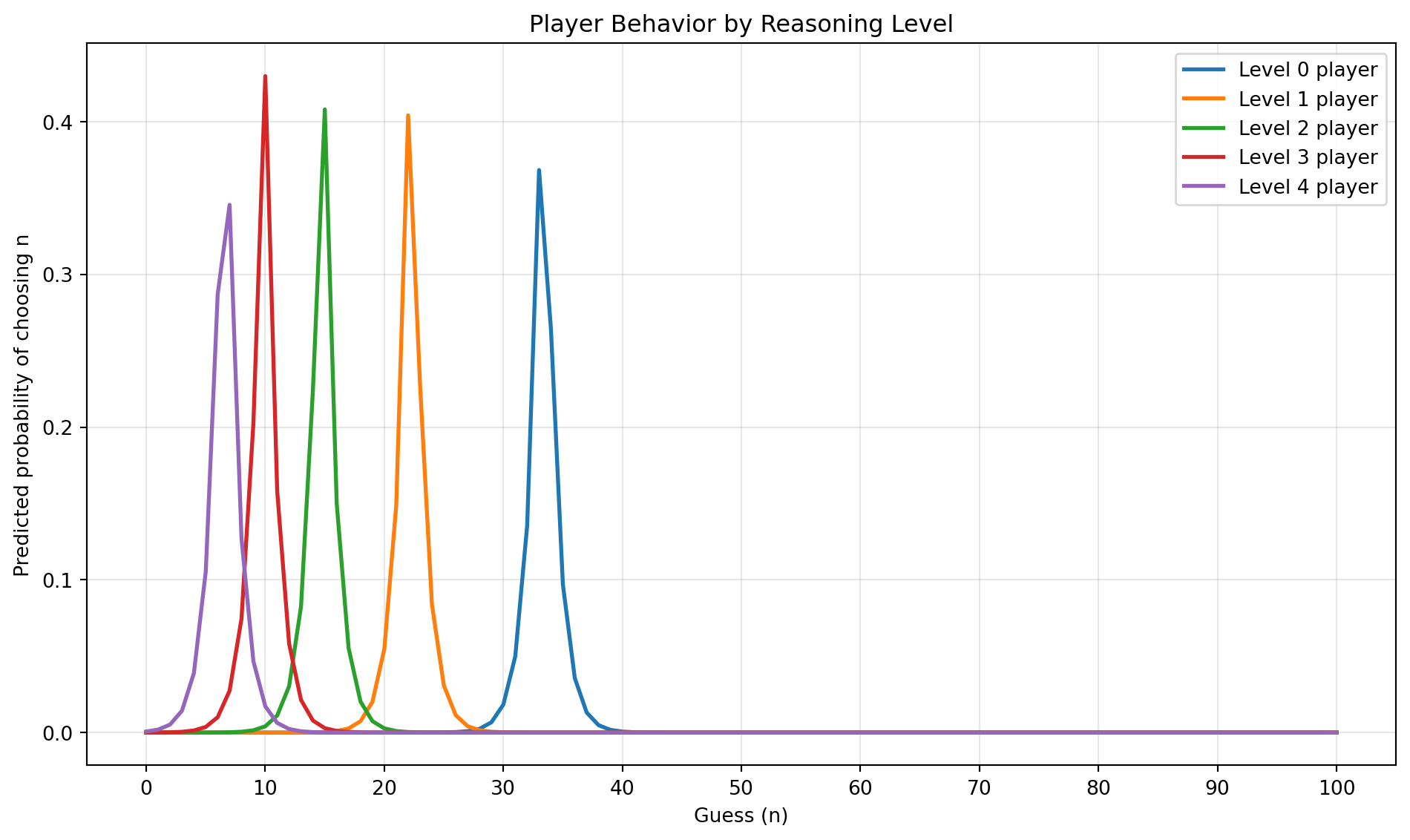
Interpretation
- Level 0: Uniform distribution (random guessing)
- Level 1: Best responds to random players, peaks near 33 (2/3 of 50)
- Level 2: Best responds to level-1 players, peaks near 22
- Higher levels: Distributions converge toward 0 (the Nash equilibrium)
The beta parameter controls how “rational” players are:
- Low beta: more random choices
- High beta: more deterministic best-response
Exploring Rationality
fig2, axes = plt.subplots(1, 3, figsize=(14, 4))

betas = [0.1, 1.0, 5.0]
for ax, beta in zip(axes, betas):
    for lvl in range(4):
        dist = player(lvl, beta=beta)
        ax.plot(N, dist, label=f'Level {lvl}')
    ax.set_title(f'beta = {beta}')
    ax.set_xlabel('Guess')
    ax.set_ylabel('Probability')
    ax.legend()
    ax.grid(True, alpha=0.3)

plt.suptitle('Effect of Rationality Parameter (beta) on Player Distributions')
plt.tight_layout()
plt.show()
Text(0.5, 1.0, 'beta = 0.1')Text(0.5, 0, 'Guess')Text(0, 0.5, 'Probability')Text(0.5, 1.0, 'beta = 1.0')Text(0.5, 0, 'Guess')Text(0, 0.5, 'Probability')Text(0.5, 1.0, 'beta = 5.0')Text(0.5, 0, 'Guess')Text(0, 0.5, 'Probability')Text(0.5, 0.98, 'Effect of Rationality Parameter (beta) on Player Distributions')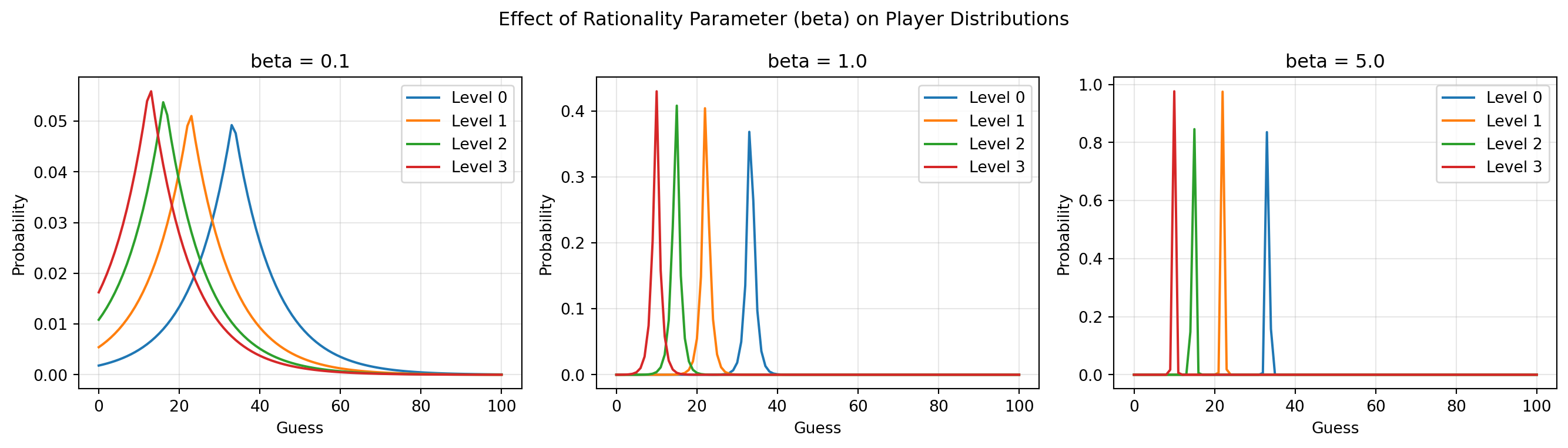
Running This Locally
To run this notebook interactively with full editing capabilities:
cd project
uv run marimo edit quartobook/notebooks_exported/demo-marimo.py