from enum import IntEnum

import jax.numpy as jnp

from memo import domain as product
from memo import memo

Die = jnp.arange(6) + 1
Dice = product(d1=Die.size, d2=Die.size)


class Coin(IntEnum):
    TAILS = 0
    HEADS = 1


class Outcome(IntEnum):
    LOSE = 0
    WIN = 1


def sum_dice(d):
return Die[Dice.d1(d)] + Die[Dice.d2(d)]Causal superseding
Modeling sufficiency and necessity in causal attribution
Inspired by: Kominsky et al. (2015), “Expt. 4”.
Domain
Memo Models
Conjunctive structure
Win iff (\text{coin}{=}H) \land (\text{dice} > \theta)
@no_type_check
@memo
def conjunctive_sufficiency[_coin: Coin](threshold, saliency):
    """
    Sufficiency: P(Y_{C←c, D←D*} = win)

    Potential outcome Y under intervention do(C=c) with counterfactual dice
    D* ~ P(D) · exp(-λ · 𝟙[D > θ]), where λ is the saliency parameter.
    """
    observer: thinks[
        alex: draws(d in Dice, wpp=1),
        alex: draws(c in Coin, wpp=1),
        alex: assigned(result in Outcome,
            wpp=1 if result == (sum_dice(d) > threshold and c == {Coin.HEADS}) else 0),
    ]
    observer: observes_that[sum_dice(alex.d) == 12]
    observer: observes_that[alex.c == {Coin.HEADS}]
    return observer[wonders[
        do(alex.c is _coin),
        do(alex.d, wpp=exp(-saliency * (sum_dice(d) > threshold))),
        E[alex.result == {Outcome.WIN}]
    ]]


@no_type_check
@memo
def conjunctive_necessity[_coin: Coin](threshold):
    """
    Necessity: P(Y_{C←c, D←d} = win)

    Potential outcome Y under intervention do(C=c), holding dice at
    factual value d (here d s.t. sum(d) = 12).
    """
    observer: thinks[
        alex: draws(d in Dice, wpp=1),
        alex: draws(c in Coin, wpp=1),
        alex: assigned(result in Outcome,
            wpp=1 if result == (sum_dice(d) > threshold and c == {Coin.HEADS}) else 0),
    ]
    observer: observes_that[sum_dice(alex.d) == 12]
    observer: observes_that[alex.c == {Coin.HEADS}]
    return observer[wonders[
        do(alex.c is _coin),
        E[alex.result == {Outcome.WIN}]
    ]]
Disjunctive structure
Win iff (\text{coin}{=}H) \lor (\text{dice} > \theta)
@no_type_check
@memo
def disjunctive_sufficiency[_coin: Coin](threshold, saliency):
    """
    Sufficiency: P(Y_{C←c, D←D*} = win)

    Potential outcome Y under intervention do(C=c) with counterfactual dice
    D* ~ P(D) · exp(-λ · 𝟙[D > θ]).
    """
    observer: thinks[
        alex: draws(d in Dice, wpp=1),
        alex: draws(c in Coin, wpp=1),
        alex: assigned(result in Outcome,
            wpp=1 if result == (sum_dice(d) > threshold or c == {Coin.HEADS}) else 0),
    ]
    observer: observes_that[sum_dice(alex.d) == 12]
    observer: observes_that[alex.c == {Coin.HEADS}]
    return observer[wonders[
        do(alex.c is _coin),
        do(alex.d, wpp=exp(-saliency * (sum_dice(d) > threshold))),
        E[alex.result == {Outcome.WIN}]
    ]]


@no_type_check
@memo
def disjunctive_necessity[_coin: Coin](threshold):
    """
    Necessity: P(Y_{C←c, D←d} = win)

    Potential outcome Y under intervention do(C=c), holding dice at
    factual value d.
    """
    observer: thinks[
        alex: draws(d in Dice, wpp=1),
        alex: draws(c in Coin, wpp=1),
        alex: assigned(result in Outcome,
            wpp=1 if result == (sum_dice(d) > threshold or c == {Coin.HEADS}) else 0),
    ]
    observer: observes_that[sum_dice(alex.d) == 12]
    observer: observes_that[alex.c == {Coin.HEADS}]
    return observer[wonders[
        do(alex.c is _coin),
        E[alex.result == {Outcome.WIN}]
    ]]
Computing measures
def get_measures(saliency=1.0):
    """Compute sufficiency and necessity for all conditions via memo."""
    conditions = [
        ('conj_likely', conjunctive_sufficiency, conjunctive_necessity, 2),
        ('conj_unlikely', conjunctive_sufficiency, conjunctive_necessity, 11),
        ('disj_likely', disjunctive_sufficiency, disjunctive_necessity, 2),
        ('disj_unlikely', disjunctive_sufficiency, disjunctive_necessity, 11),
    ]
    results = {}
    for name, sufficiency_fn, necessity_fn, threshold in conditions:
        sufficiency = float(sufficiency_fn(threshold, saliency)[Coin.HEADS])
        necessity = 1 - float(necessity_fn(threshold)[Coin.TAILS])
        results[name] = {'sufficiency': sufficiency, 'necessity': necessity}
    return results
Results
Sufficiency and necessity across four conditions (threshold \theta \in \{2, 11\}, structure \in \{\land, \lor\}):
import numpy as np
from matplotlib import pyplot as plt
from matplotlib.patches import Patch

# Pre-computed measures (saliency λ = 1.0)
measures = {
    'conj_likely':   {'sufficiency': 0.8824, 'necessity': 1.0},
    'conj_unlikely': {'sufficiency': 0.0270, 'necessity': 1.0},
    'disj_likely':   {'sufficiency': 1.0,    'necessity': 0.0},
    'disj_unlikely': {'sufficiency': 1.0,    'necessity': 0.0},
}

cond_order = ['conj_likely', 'conj_unlikely', 'disj_likely', 'disj_unlikely']

print(f"{'Condition':<18} {'Sufficiency':>12} {'Necessity':>10}")
print("-" * 45)
for c in cond_order:
    m = measures[c]
    print(f"{c:<18} {m['sufficiency']:>12.4f} {m['necessity']:>10.4f}")
Condition Sufficiency Necessity
---------------------------------------------
conj_likely 0.8824 1.0000
conj_unlikely 0.0270 1.0000
disj_likely 1.0000 0.0000
disj_unlikely 1.0000 0.0000Empirical data
Causal ratings from Kominsky (2015), Experiment 4 (7-point scale):
empirical = {
    'conj_likely': 5.19,
    'conj_unlikely': 2.88,
    'disj_likely': 4.27,
    'disj_unlikely': 4.46,
}
empirical_scaled = {k: v / 7 for k, v in empirical.items()}
Model fitting
Fit \beta via least squares: \text{rating} = \beta \cdot S + (1-\beta) \cdot N
def fit_beta(measures, empirical):
    """Fit β in: rating = β·sufficiency + (1-β)·necessity"""
    conditions = list(measures.keys())
    suff = np.array([measures[c]['sufficiency'] for c in conditions])
    nec = np.array([measures[c]['necessity'] for c in conditions])
    y = np.array([empirical[c] for c in conditions])

    # rating = β·suff + (1-β)·nec = nec + β·(suff - nec)
    diff = suff - nec
    y_centered = y - nec
    beta = np.dot(diff, y_centered) / np.dot(diff, diff)
    return float(np.clip(beta, 0, 1))

beta = fit_beta(measures, empirical_scaled)
print(f"Fitted β = {beta:.4f}")
Fitted β = 0.6250Predictions
def compute_r2(predicted, actual):
    """Compute R² between predicted and actual values."""
    conditions = list(predicted.keys())
    y_pred = np.array([predicted[c] for c in conditions])
    y_true = np.array([actual[c] for c in conditions])
    ss_res = np.sum((y_true - y_pred) ** 2)
    ss_tot = np.sum((y_true - np.mean(y_true)) ** 2)
    return 1 - ss_res / ss_tot

model_preds = {
    c: beta * measures[c]['sufficiency'] + (1 - beta) * measures[c]['necessity']
    for c in measures
}

r2 = compute_r2(model_preds, empirical_scaled)
print(f"R² = {r2:.4f}")
R² = 0.3863Code
fig, axes = plt.subplots(1, 2, figsize=(10, 4))
positions = [0.75, 1.25, 1.75, 2.25]
bar_width = 0.4
light_grey, dark_grey = "#AAAAAA", "#444444"
colors = [light_grey, dark_grey, light_grey, dark_grey]

for ax, data, title in [
    (axes[0], empirical_scaled, "Empirical"),
    (axes[1], model_preds, f"Model (R² = {r2:.2f})")
]:
    values = [data[c] for c in cond_order]
    ax.bar(positions, values, width=bar_width, color=colors, edgecolor='black')
    ax.set_ylim(0, 1.1)
    ax.set_xlim(0.25, 2.75)
    ax.set_xticks([1, 2])
    ax.set_xticklabels(["Conjunctive", "Disjunctive"])
    ax.set_ylabel("Rating (scaled)")
    ax.set_title(title)

fig.legend([Patch(facecolor=light_grey, edgecolor='black'),
            Patch(facecolor=dark_grey, edgecolor='black')],
           ['Likely (θ=2)', 'Unlikely (θ=11)'],
           loc='upper right', bbox_to_anchor=(0.98, 0.88))
plt.tight_layout()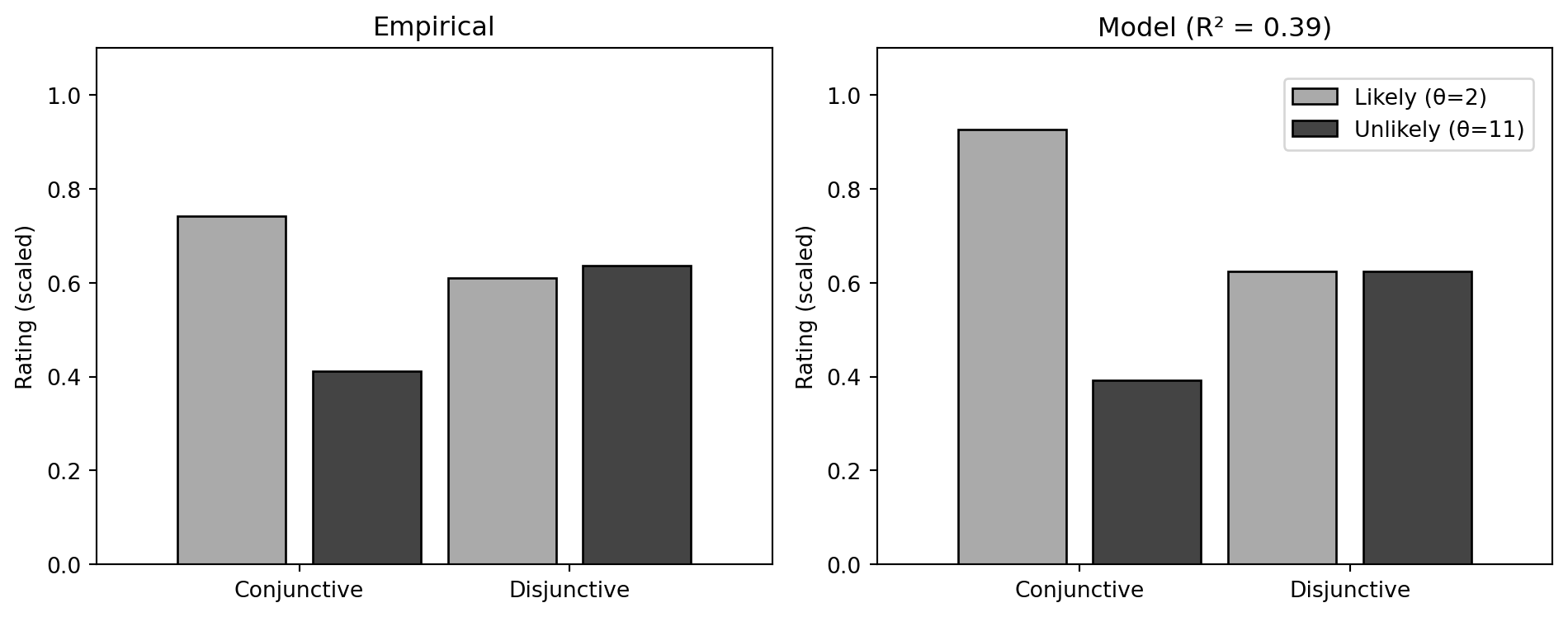
Model comparison
models = {
    'Sufficiency only': {c: measures[c]['sufficiency'] for c in measures},
    'Necessity only': {c: measures[c]['necessity'] for c in measures},
    'β·S + (1-β)·N': model_preds,
}

print(f"{'Model':<20} {'R²':>10}")
print("-" * 35)
for name, preds in models.items():
    r2 = compute_r2(preds, empirical_scaled)
    print(f"{name:<20} {r2:>10.4f}")
Model R²
-----------------------------------
Sufficiency only -6.9140
Necessity only -19.8855
β·S + (1-β)·N 0.3863print(f"\n{'Condition':<16} {'Emp':>8} {'Suff':>8} {'Nec':>8} {'Model':>8}")
print("-" * 55)
for c in cond_order:
print(f"{c:<16} {empirical_scaled[c]:>8.3f} "
f"{measures[c]['sufficiency']:>8.3f} "
f"{measures[c]['necessity']:>8.3f} "
f"{model_preds[c]:>8.3f}")
Condition             Emp     Suff      Nec    Model
-------------------------------------------------------
conj_likely         0.741    0.882    1.000    0.927
conj_unlikely       0.411    0.027    1.000    0.392
disj_likely         0.610    1.000    0.000    0.625
disj_unlikely       0.637    1.000    0.000    0.625
References
Kominsky, Jonathan F., Phillips, Jonathan, Gerstenberg, Tobias, Lagnado, David, & Knobe, Joshua. (2015). Causal superseding. Cognition, 137, 196–209. https://doi.org/10.1016/j.cognition.2015.01.013